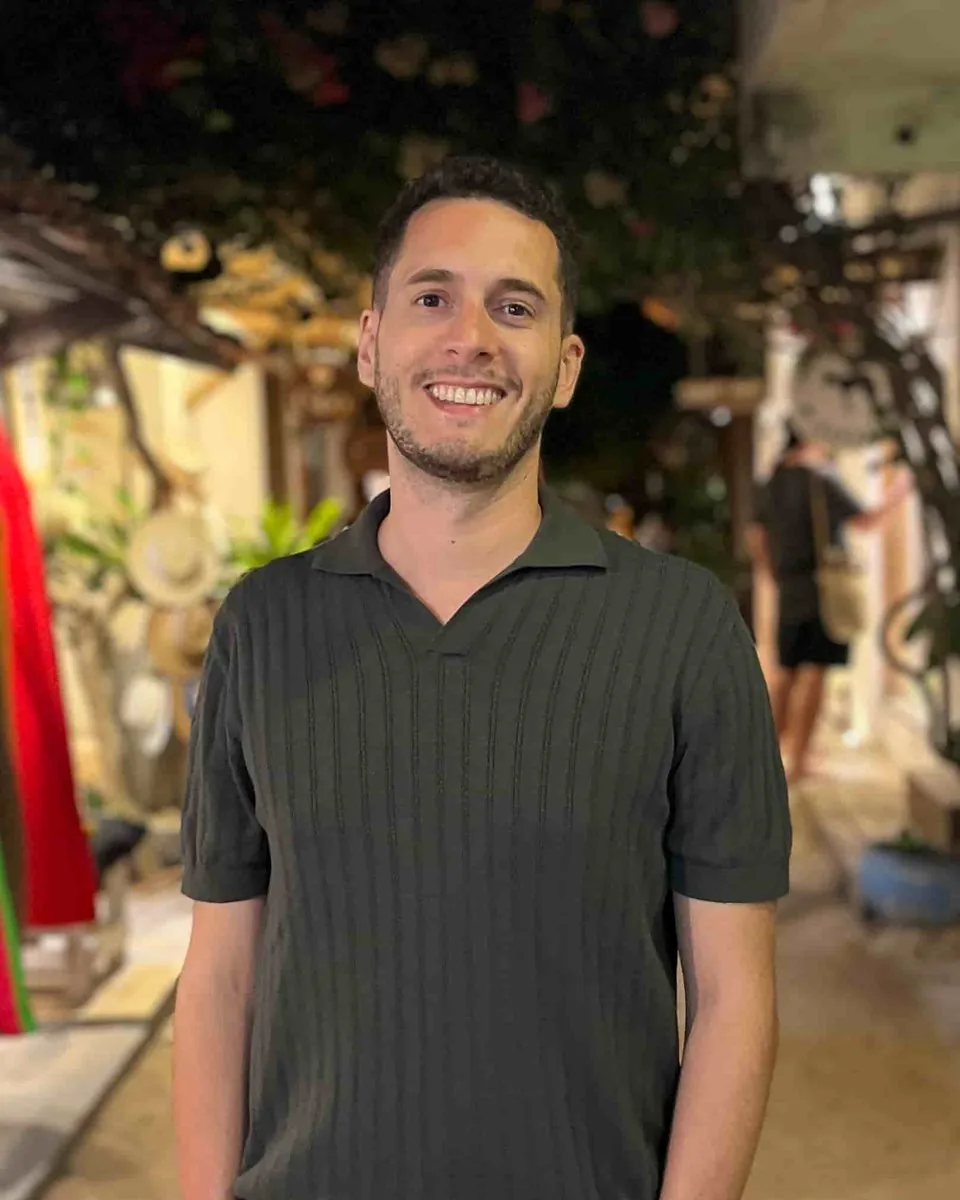
Today I speak five languages (Spanish, Portuguese, English, German and French), but it wasn't always like that.
For years I was a very average student and I thought that learning a language meant suffering through rules, forgetting them a week later and then trying the next app to suffer some more. I spent an embarrassing amount of money on apps, grammar books and private lessons that always started with a verb table.
Which was a problem, because I have a very serious allergy to grammar. The symptoms are heavy eyes, sudden boredom and waking up twenty minutes later with my face on a page about the subjunctive.
It got so bad that I went to the doctor. He looked at me very seriously and said:
Gabriel, there is no cure. But try stories.
So I did. I started reading stories I actually enjoyed, every day, in the languages I was learning. At the beginning I understood maybe half and I kept going anyway because I was enjoying it more than any lesson I ever had.
With time, the half I didn't understand started getting smaller and smaller, and things that never made sense to me in a grammar book or inside a classroom, like when to use one past tense or the other, started to make sense on their own.
Now I knew exactly how they worked, the same way native speakers do. And just like them, I can't explain the rules… which is a funny thing to admit for someone who teaches languages.
So yeah.. that's pretty much my whole secret and sometimes it's hard to believe how simple it is.
All the money I spent on apps and grammar books, think of it as an investment I made for you. I already paid for all the mistakes so you can go straight to the part that works.
How it started
In 2024 I was living in Switzerland, I had a job, a nice life and I had finally understood the Swiss recycling rules. If my life was one of my stories, this is the part where everything is a bit too perfect and you just know something bad is about to happen. And it did… I lost my job.
No problem, I thought. I have an MBA and a CV I'm really proud of. How hard can it be? I'll find something in a few weeks.
Spoiler: it was very hard. More than 500 rejections later I had to admit I was a bit too optimistic. I'm almost sure I hold the Guinness World Record for rejections. I always tell my friends I'd apply for it, but they'd probably reject me too.
I'm not going to lie… I was mildly depressed. I felt lost, I didn't know what I was good at anymore and every rejection made me feel a bit smaller.
And my head started going to the worst places. I was already comparing bridges the way you compare apartments, close to a supermarket, not too windy and with quiet neighbors. And if it really came to that, at least it would be a Swiss bridge.. those are very clean.
Then one night at 2 in the morning, sitting in my kitchen, I had one thought:
Ok, I don't know what I'm doing with my life but I do know how to learn languages. Maybe I can teach someone...
I had no teaching experience and no plan, but stories were how I learned every new language. And it just so happened that I'd also been writing them in my diary since I was a kid (always too shy to show them to anyone).
So instead of teaching grammar (allergy, remember?), I wrote a few short stories in Spanish and started giving lessons online. And I had no idea if what worked for me would work for anyone else.
Samuel's wedding speech
The first person to read them was Samuel, my first student. He wanted to surprise his Spanish girlfriend with a speech in Spanish at their wedding, and on paper he was ready. He had finished textbooks, done a grammar course and had a 200+ day streak on a language app.
Then I asked him in Spanish what he did on the weekend and he looked at me like the 200 days had never happened. He told me he thought he was just bad at languages.
So I gave him the same prescription the doctor gave me: read the stories and enjoy them, nothing else. After a few stories he was noticing patterns on his own and understanding things I had never explained to him.
A few months later he got married, gave the speech in Spanish and sent me the video. I'm not sure who cried more watching it… me or the bride.
And it wasn't just Samuel. Every student after him started picking things up the same way, and they all kept asking me the same thing.. can you write more stories?
At some point it felt kind of selfish to keep them for a few people on video calls. So I decided to put them online for free, and that's how Fluent with Stories started.
There was just one small problem. I had zero technical background and no idea how to build a website. So I spent about 4 months learning from zero, every single day, breaking things and fixing them again.
Everything you see here I built or wrote myself, except the illustrations, because if I had drawn them you would have left the website in about two seconds and you wouldn't be reading this.
And when I finally launched it I had an anxiety attack. Showing my stories to a few students was one thing, but now anyone in the world could read them and I really thought nobody would like them.
Well, it turns out that people did.. and here we are.
Where it is today.
Somewhere in the middle of all this I left Switzerland and moved to Portugal and now I live close to the beach.
Today hundreds of thousands of people from all over the world read the stories and my Spanish books have an average of 4.8 stars on Amazon.
But the numbers are not what makes me happy.. it's the messages.
I get thank you emails from everywhere. Teachers who use the stories with their students, adults who learn after work, retired people who finally have time for Spanish and even parents and grandparents who read the stories with their kids and have a great time together.
I never imagined any of this when I was sitting in my kitchen at 2 in the morning. Helping people learn Spanish and actually have fun doing it is the thing I'm most proud of, and I'm not going to lie, some of those emails make me a bit emotional.
I still write every story myself and I write them all by hand. It's way slower, I know, but there's something about pen and paper that I can't really explain.
And where the ideas come from is a mystery even to me.. sometimes my mind just gets creative and an idea shows up out of nowhere, on a walk on the beach or at 3 in the morning when I should be sleeping.
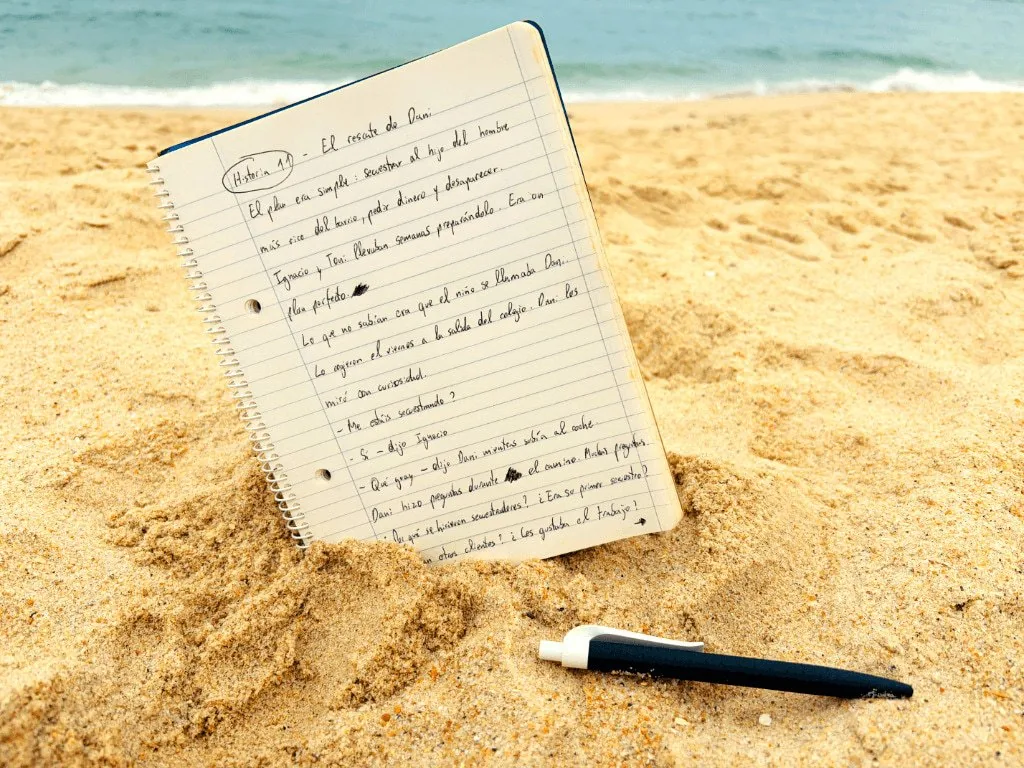
Oh and if you're wondering, no.. nobody has ever asked me for an autograph. But I carry a pen in my pocket every day just in case.
What I believe.
After talking with a lot of readers and students, I realized that many of them think they're just bad at languages.
I don't think anyone is bad at languages.
I think most people just haven't found the method that works for them yet.
And school is the best proof. Think about the language you studied in a classroom for years.. can you actually speak it? Most people can't, and that's not their fault.
Grammar tables and apps are great for passing tests and keeping streaks but that's also how you end up like Samuel, with a 200-day streak and no answer when someone asks about your weekend (sorry Samuel, but it's true).
For me, for Samuel and for a lot of my readers, that method is stories, and I really believe it's the best way to learn a language. But not those boring stories with no plot, where María goes to school and Carlos eats bread.
I mean real stories, with romance, bad decisions and plot twists, where you can't stop reading until you find out if she says yes, if he's lying and who had the terrible idea of inviting the ex to the wedding.
And when you enjoy what you're reading you don't have to force yourself to keep going. You just come back the next day because you actually want to, not because an app sent you a notification to make you feel guilty.
That's the part most people don't realize, because learning a language isn't about studying for three hours on a Sunday. It's about doing a little bit every day and that's much easier when it doesn't feel like homework.
The context makes a big difference too. When you learn a word inside a story, you don't just remember the word, you remember who said it, where they were and why it was funny. And that's why you still remember it a week later and not just until the next test.
Comments section for language learners