Spanish Short Story Books for Beginners & Intermediates (A1–B2).
Short, funny Spanish stories with the English translation sentence by sentence: Spanish on one line, English right under it, so you never get stuck or reach for a dictionary. Learn the words people really use, from your first day to upper-intermediate.
Sold on Amazon · As an Amazon Associate I earn from qualifying purchases.
Which book is for me? Read one line from each.
Each line is from one of the stories. Start at A1 and stop at the first one you can't follow without the English. That's your book. If you breeze through all four, B2 it is.
“Sale de casa, cierra la puerta y corre a la parada del autobús.”
She leaves the house, closes the door and runs to the bus stop.
Short sentences, present tense, everyday words. If this is already easy, try the next line.
“No se han visto en tres años, desde el divorcio.”
They haven't seen each other in three years, since the divorce.
Past tenses show up, stories get a plot. You understand your teacher, but not yet a real conversation.
“Su dueño era Don Javier, un hombre muy rico que había empezado con un terreno pequeño y ahora tenía viñedos hasta donde alcanzaba la vista.”
Its owner was Don Javier, a very wealthy man who had started with a small plot of land and now owned vineyards as far as the eye could see.
Mixed tenses, longer sentences, a bit of slang. You get by, but native speed still hurts.
“¿Estaría Lucas engañando a su novia una semana antes de casarse? Eso no tenía buena pinta.”
Could Lucas be cheating on his girlfriend a week before getting married? It didn't look good.
Subjunctive, irony, people not saying what they mean. If this reads like a normal sentence, you are a reader now.

Spanish Short Stories A1
This is the book I wish I had when I started Spanish. Ten very short stories about normal life: Carmen running late for work, Roberto losing a spicy-food challenge at a Mexican restaurant, a monkey called Martín who disappears from the zoo every Monday. Short sentences, present tense, and the vocabulary you actually say on day one in Spain or Mexico.
Every sentence has its English translation right under it, so you never get stuck, and a vocabulary section so you don't need a dictionary. Read one story a day and you'll understand basic conversations in about two weeks.

150 Phrases Through Spanish Short Stories A1
Textbooks teach you “¿Cómo está usted?”. Nobody says that. This book is the opposite: 150 phrases native speakers really use, each one inside a story so you see when people say it, then a breakdown of what it means, how it changes in Spain vs Latin America, and what to answer back.
Ten exclusive stories you won't find on the website. If you've done the A1 stories book and want to sound less like a textbook, this is the next one.

Spanish Short Stories A2
At A2 the stories get a plot. Elena's ex-husband sits next to her on a flight. Alejandra goes from supermarket cashier to millionaire and finds out it's not what she expected. Two brothers get caught in La Tomatina. You start seeing the past tenses, connectors, and the little words that make Spanish sound like Spanish.
Still short, still translated sentence by sentence. This is the book where most people tell me “I understood a whole conversation this week.”

Spanish Short Stories B1
Intermediate is where most people get stuck: you understand your teacher but not the taxi driver. These eight stories are written the way Spanish speakers actually tell stories, with the tenses mixed, dialogue that interrupts itself, and a bit of slang. A winemaker in La Rioja, a photographer trying to save a village tradition, 94 million euros that ruin a family.
Longer stories, fewer of them, because at this level you need to stay inside one world for a while. The translation is still there, sentence by sentence, but you'll use it less and less.

Spanish Short Stories B2
Six stories that are just stories. A kiss that ends a friendship, a detective called Mateo and his suspicious bride, a birthday promise nobody should have made. Subjunctive, idioms, irony, people not saying what they mean. If you can follow these without the translation, you're not a learner anymore, you're a reader.
The translation is still there for the three sentences per story where you'll want it.
What readers say.
“I LOVE LOVE LOVE it! Probably the best language learning I've explored so far. Duolingo was a good start for learning some words… but for me, nothing compares to reading.”
“I already see more progress than in years of studying other languages in the ‘normal’ way. Some of the biggest improvement I saw is with your stories.”
“The stories are great; really entertaining… I haven't looked at a grammar book all week!”
All the Spanish story books, A1 to B2, in one bundle.
From “hola” to the subjunctive. Start easy and keep reading until the hard book becomes the easy one.
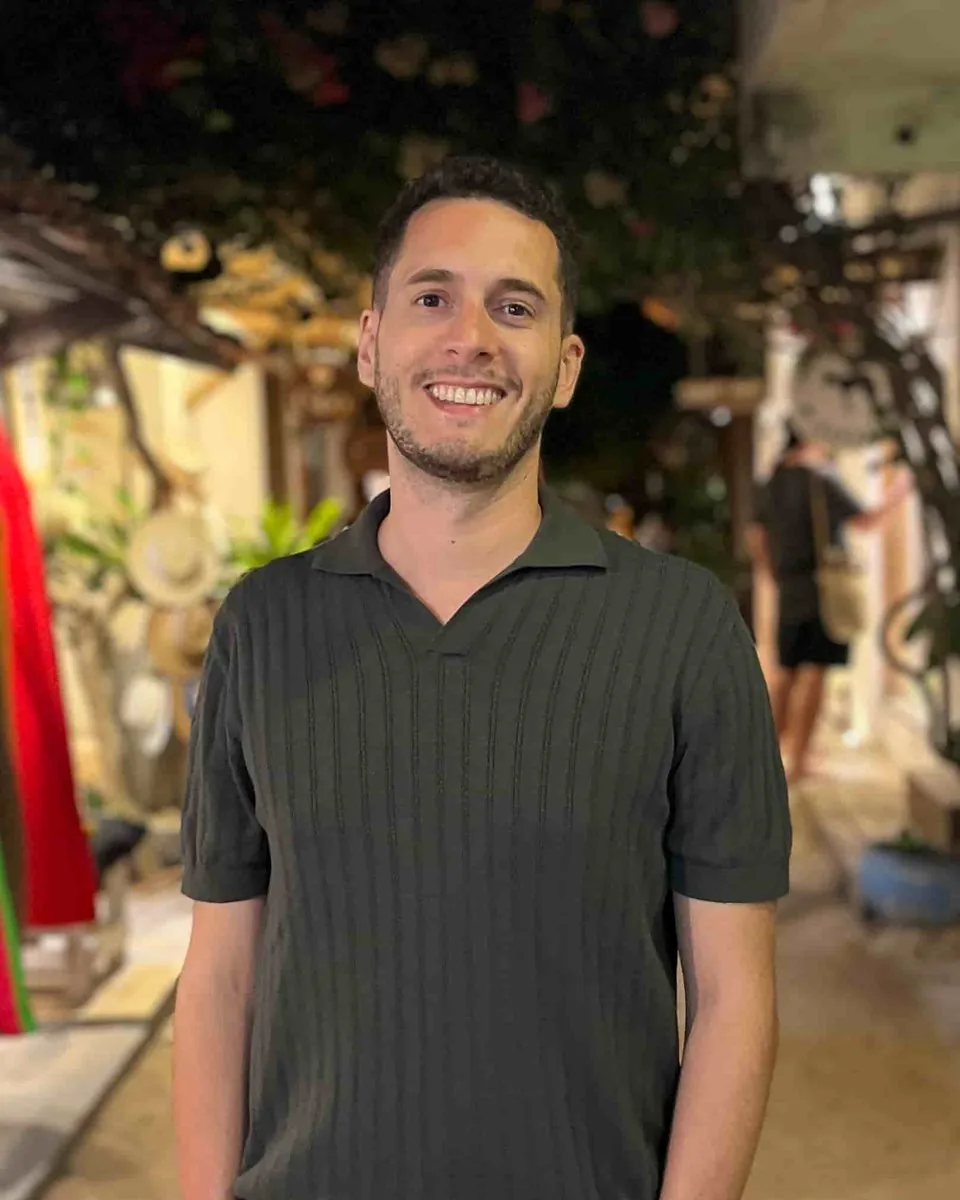
Meet the guy behind the stories.
I'm allergic to grammar. I speak five languages and never learned any of them from a conjugation table. I learned them all the same way: by reading things until they made sense. So when I started helping people learn Spanish, I wrote them stories instead. Hundreds of thousands of readers later, these books are everything I wish existed when I was learning my second language.
Gabriel Beirão
Read my full story →FAQ.
What's the best Spanish book for a complete beginner?
Spanish Short Stories A1. Ten very short stories, present tense, the words you'd use on your first day in Spain or Mexico, with the English next to every sentence. If you already know a few hundred words and want to sound less like a textbook, go for 150 Phrases A1.
And for intermediate learners?
B1 if you understand your teacher but not the taxi driver. B2 if you read the news in Spanish and want fiction that feels like fiction. Not sure? Read one line from each level above and stop at the first one you can't follow without the English.
Is there a free PDF?
Yes, one: 100 Must-Know Spanish Phrases Through Short Stories, a free story-based ebook you get when you join the newsletter. And most of the stories in these books are free to read on this website, with slow audio and exercises. The paid books are for reading offline, on paper or Kindle, with everything in one place.
Are these the same stories as the free ones on the website?
Mostly, yes. The A1, A2, B1 and B2 books are the website stories, cleaned up and laid out for reading on paper, with the sentence-by-sentence translation and vocabulary sections. 150 Phrases is different: ten stories you won't find anywhere else, built around the phrases.
Do the books have an English translation?
Yes, sentence by sentence: every Spanish sentence has its English right under it. Most bilingual books put the translation on the facing page or at the back, so you lose the thread every time you look something up. Here you glance down, get the sentence, and keep reading. No dictionary, no flipping.
What type of Spanish is it?
Neutral Spanish that works everywhere. You know how Americans say “elevator” and British people say “lift” and nobody has a problem understanding each other? Same with Spanish: about 95% of the language is identical from Madrid to Mexico City. Where a word does change, I tell you.
A1, A2, B1, B2… what does that mean?
It's the CEFR scale, how language levels are measured pretty much everywhere. A1 is “I know hola and gracias”, A2 is “I can follow a simple conversation”, B1 is “I'm getting comfortable”, B2 is “I can handle real Spanish”. Each book covers one level, in order.
eBook or paperback?
Same content. Paperback if you like underlining and covering the English with your hand. eBook if you read on a Kindle, phone or tablet and want it with you everywhere. The eBook is $2.99, the paperback $12.99, and the bundle gets you all of them at once.
Can I use them with my kids, a teacher or my students?
Yes. All the content is safe: real-life stories, nothing inappropriate. Families use them for home education and lots of teachers use them in class. If you're a school and want the full course for your students, there's a classroom plan.
Still have questions?
I'm happy to help. Email me at hello@fluentwithstories.com and I'll get back to you personally.